How do you tell the rarity of a Yu-Gi-Oh! card?
Look at the name, the artwork and the border together, then confirm the printing using its set code. A shiny picture alone is not enough. Two copies of the same monster can have identical artwork and different foil finishes.
This guide covers the main English TCG rarity families, older special finishes still found in collections, and regional names you may encounter when buying Japanese OCG cards. It also separates Rush Duel, a different card game. Reviewed 20 September 2026. “Available” here includes existing collector-market printings; it does not mean every rarity is being printed in today's booster packs. Regional promotional treatments and one-off prizes do not form a single universal rarity ladder.
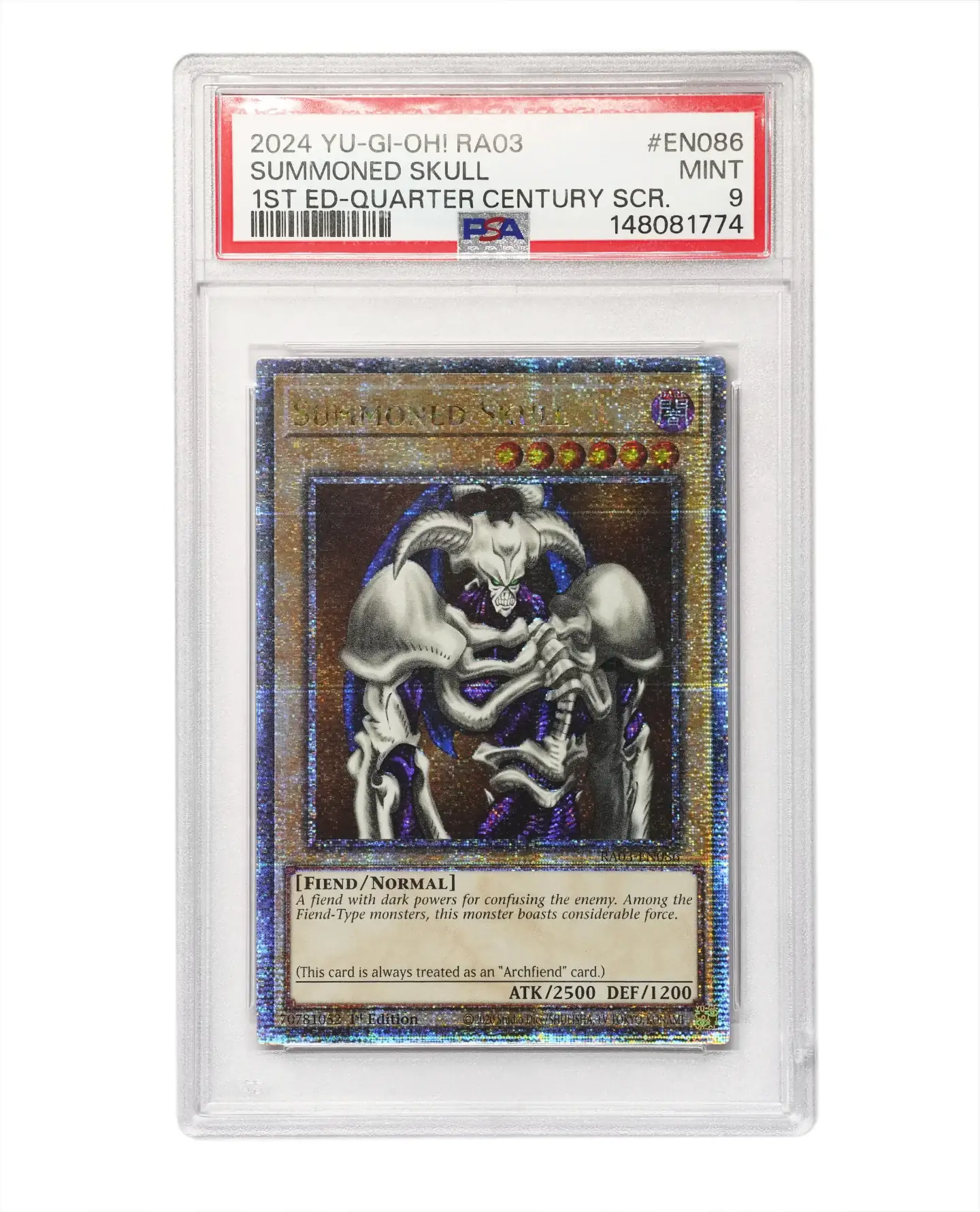
Start with the annotated photograph above. It shows one real Quarter Century Secret Rare, not a simulation of every finish. A still photograph cannot reproduce the way foil changes under a light.
The five checks to make before naming a rarity
- Name: is it ordinary ink, metallic silver, metallic gold or a rainbow reflection? Tilt the card gently; reflections can make gold appear almost black in a photograph.
- Artwork: does only the picture shine? Look for smooth foil, diagonal sparkle, a square grid or a pale three-dimensional image.
- Outside the picture: inspect the outer edge and the frame around the description. Foil extending into these areas is a useful clue.
- Texture or symbols: look for embossed detail, tiny repeated shapes, a special anniversary watermark or serial numbering. Inspect visually rather than rubbing the surface.
- Printing: read the set code, language and edition. Match the combination against the product's card list, not just an image search for the monster's name.
Use indirect daylight or a small lamp moved to the side. Take one straight-on photograph and one at an angle. If buying online, ask for those two views when the finish is unclear. Glare from a sleeve or graded holder can hide the very detail you need.
Basic Yu-Gi-Oh! rarity chart: start here
These are the quickest visual distinctions. They describe typical printings; special colour variants and changes between eras are covered below.
| Rarity | Name | Artwork | First clue |
|---|---|---|---|
| Common (C) | Ordinary ink | No foil | Neither name nor picture sparkles |
| Rare (R) | Usually silver foil | No foil | Shiny lettering, plain picture |
| Super Rare (SR) | Ordinary ink | Foil | Shiny picture, plain lettering |
| Ultra Rare (UR) | Usually gold foil | Foil | Gold name plus shiny picture |
| Secret Rare (ScR) | Rainbow/silver foil | Diagonal sparkling pattern | Check the direction of the sparkle |
| Ultimate Rare (UtR) | Usually gold foil | Embossed detail | Texture rather than a smooth picture |
| Ghost Rare (GR) | Reflective lettering | Pale, dimensional image | Picture changes dramatically with angle |
Visual reference: Yu-Gi-Oh! Card Guide's rarity illustrations. Use the photographs to compare the finish, rather than treating rarity as a price ranking.
Super Rare vs Ultra Rare: check the name first
Both have a foil picture. The practical first check is the lettering: an ordinary Super Rare has an ink name, while a standard Ultra Rare has a gold foil name. Do not decide from the frame colour. A green Spell Card and a purple Trap Card can share the same rarity.
Rare vs Ultra Rare: gold lettering is not enough
A Rare normally has silver lettering and a non-foil picture. Some releases deliberately change the name colour. Maximum Gold, for example, includes gold-letter Rares as well as Premium Gold Rares. A gold name with a plain picture should not automatically be labelled Ultra Rare. Konami's Maximum Gold description confirms both treatments.
Secret, Prismatic, Platinum, Starlight and Quarter Century
“Secret” is a family of names, not one interchangeable finish. When comparing listings, spell out the full rarity rather than relying on abbreviations such as SCR or PSR, which sellers may use differently.
| Finish | Where to look | How to avoid a mix-up |
|---|---|---|
| Secret Rare | Diagonal sparkle in the artwork | Do not call every shiny card Secret Rare |
| Prismatic Secret Rare | Grid-like sparkle in the picture | Distinguish an artwork-focused finish from an all-over treatment |
| Platinum Secret Rare | Broad Secret-style sparkle | Check the set: older and Rarity Collection versions differ |
| Starlight Rare | Fine grid sparkle across much of the face and border | Check lettering, border and the exact printing together |
| Quarter Century Secret Rare (QCSR / 25th) | Gold name and 25th-anniversary watermark | Find the anniversary mark; sparkle alone is inconclusive |
Prismatic Secret Rare is an established TCG label: it appears in Konami's 2020 Tin of Lost Memories contents. It is not a shorthand for every rarity with “Prismatic” in its name.
Quarter Century Secret Rare and Starlight Rare are particularly easy to confuse in photographs. Look for the 25th-anniversary watermark in the text-box area, then check the name. The watermark may be faint under direct light. Its absence in one photograph is not proof that it is absent on the card. Konami explicitly describes the anniversary watermark in Rarity Collection II.
A 2026 update: newer Starlights and Grand Master Rares
Older photographs are not a perfect reference for every new Starlight. Konami describes the Starlights in Magnificent Monsters, released on 4 September 2026 in North America, as using rainbow borders rather than the earlier grey appearance, with improved colour and visibility.
The same release introduces Grand Master Rares to the TCG: hieroglyphic borders and serial numbers are the key identifiers. For each of its 18 eligible cards, Konami specifies 100 for the Americas and another 100 for markets supplied from Europe, with an E suffix on the latter. Do not mistake a grading company's certificate number for a serial number printed on the card. Source: Konami, Magnificent Monsters.
Ultimate Rare and Collector's Rare: why texture matters
A picture can flatten an embossed surface. Look at an angled view of the artwork, stars and frame. Texture should be assessed against the same set and printing, because it has changed over time.
Collector's Rare (CR) uses a textured, patterned finish; the frame is a particularly useful place to inspect. It is a separate label from Ultimate Rare. King's Court is one example of a release with Collector's Rare versions, confirmed in Konami's set description.
Prismatic Collector's Rare (PCR) and Prismatic Ultimate Rare (PUR) refer to the Rarity Collection-style technologies. Konami introduced them to the TCG in the first 25th Anniversary Rarity Collection, describing extra sparkle for the Collector's treatment and raised three-dimensional varnish for the Ultimate treatment. They should not be silently substituted for traditional TCG Collector's or Ultimate Rares in a listing. Source: Konami, Rarity Collection.
If a listing only says “Ultimate”, ask which set it comes from. A complete description might include the card name, set code, language, edition and the full finish name. That is much more useful than “very rare holo”.
Gold, Platinum and older special finishes
These labels turn up in older binders, graded collections and reprint products. “Older” does not mean unofficial or unavailable to collectors.
| Name you may see | Identifying feature or check |
|---|---|
| Gold Rare / Gold Ultra Rare | Gold borders as well as a gold name |
| Gold Secret Rare | Gold treatment combined with Secret-style sparkle |
| Ghost Gold Rare / Gold Ghost Rare | Ghost-style picture with gold framing |
| Premium Gold Rare | Raised gold outlines and borders; inspect the artwork outline |
| Platinum Rare | Metallic platinum treatment; a different label from Platinum Secret Rare |
| Starfoil Rare | Repeated stars across the surface |
| Mosaic Rare | Small square or rectangular mosaic pattern |
| Shatterfoil Rare | Angular, shattered-glass-like pattern |
| Parallel Rare | A surface pattern added over a base rarity; specify the full label |
| Duel Terminal Parallel | A patterned finish associated with Duel Terminal printings; confirm the set code |
| Pharaoh's Rare | Tiny hieroglyphic motifs within the foil; check the base finish and region |
| Coloured-name Rare / Ultra Rare | A name-colour variant; inspect the picture before identifying the base rarity |
The older star, mosaic and shattered patterns are described in the rarity overview on German Wikipedia. For Premium Gold, Konami's Maximum Gold page describes textured gold outlines; the name does not simply mean a more expensive Gold Rare. Pharaoh's hieroglyphic treatment and Parallel variants are illustrated in Yu-Gi-Oh! Card Guide.
Parallel labels may include Normal/Common Parallel, Rare Parallel, Super Parallel, Ultra Parallel and Secret Parallel. Duel Terminal listings use similar combinations. Read both halves: one describes the base printing, the other describes the added surface treatment. The exact pattern is set-dependent.
Black Rare and White Rare describe imprinted-name variations, while Duelist League cards include coloured-name versions such as blue, red, green, purple and bronze. These are worth checking when a card looks plain until you tilt the letters. The collector photograph reference by Quuador documents these regional and historical distinctions.
For less common historical labels such as Ultra Secret Rare, Secret Ultra Rare and Holofoil Rare, verify the individual release. The word order matters. Some labels describe unusual or misprinted combinations, rather than a regular rarity you can expect in a pack. A seller's shorthand is not enough evidence to identify an unusual promotional printing.
For a second visual reference covering Gold, Platinum and Secret-family differences, see Wargamer's rarity guide. Its older release information should be read alongside the dated Konami sources in this article.
Japanese OCG rarities and regional names
The TCG is the version sold in markets including the UK; the OCG is the regional game sold in Japan and other Asian markets. Do not assume that the same English translation means an identical finish, distribution or tournament eligibility. English-language cards can also be Asian-English OCG releases.
Japan's Quarter Century Rarity Collection lists Holographic Rare, Extra Secret Rare, Secret Rare, Ultimate Rare, Collector's Rare, Ultra Rare, Super Rare and Quarter Century Secret Rare. Holographic Rare is the regional term commonly compared with Ghost Rare; use the OCG product list when identifying an OCG card.
Other names collectors encounter include 20th Secret Rare, 10000 Secret Rare, Millennium Rare, Millennium Super/Ultra/Secret Rare, Millennium Gold Rare, Millennium Prismatic Secret Rare, KC Rare, KC Ultra/Secret Rare, and Extra Secret Parallel Rare. These belong to specific regional or promotional releases rather than extra steps in the basic TCG chart. Match them to the exact product before applying a label. The official 20th Anniversary Set is an example of the 20th Secret Rare designation.
In 2026, Japan's Limit Over Collection includes Overframe artwork and Grand Master Rare serial-numbered cards. Overframe is a design treatment that can appear in more than one rarity: the official Rivals page lists Ultra Rare and Prismatic Secret Rare Overframe cards. Source: Konami Japan, Limit Over Collection — The Rivals.
The older collector reference photographs also illustrate Millennium and Extra Secret finishes. Repeated hieroglyphs point towards a Millennium treatment; a KC logo pattern calls for a KC-release check. Neither should be identified just from the name colour.
Rush Rare and Over Rush Rare belong to Rush Duel
Keep Rush Duel cards separate when sorting a collection. Rush Rare and Over Rush Rare are names used in that game; they are not synonyms for TCG Ultra Rare or Starlight Rare. Identify the game first, then use its own product checklist. This guide's standard TCG chart should not be used to certify a Rush Duel printing.
Full Over Rush Rare is another current name to recognise: Over Rush Pack 4, released in Japan on 11 April 2026, introduced it with artwork extending across the card. Its product list also distinguishes Over Rush, Ultra, Super, Normal and Secret versions. Source: Konami, Over Rush Pack 4.
Extended art is not automatically a new rarity
Alternate art changes the illustration. Extended art changes how far the illustration reaches across the card. Neither description tells you the complete foil finish by itself.
Rarity Collection V brought the first extended-art cards to the TCG in April 2026. Its main pool includes Super, Ultra, Secret, Starlight, Platinum Secret and the Prismatic-style Ultimate and Collector's finishes. Always record artwork version and rarity separately when comparing two copies. Source: Konami, Rarity Collection V.
Read the set code, edition and grade separately
In the photograph, RA03-EN086 identifies the set/language/card entry. 1st Edition identifies an edition. Quarter Century Secret Rare identifies the finish. PSA 9 is the grade shown on the holder. Those four descriptions answer different questions.
A set code may be shared by multiple rarities in a collection, so it narrows the search rather than always giving the final answer. The eight-digit card password is also not a rarity code. Search the full set code alongside the card name, then compare the eligible finishes.
The small security foil square near the bottom-right is not the same thing as a Quarter Century watermark. Do not identify rarity or authenticity from that square alone. Likewise, the stars across the top of a Monster Card describe a gameplay characteristic, not how scarce the printing is.
Before you buy a rare Yu-Gi-Oh! card online
- Match the actual photographed copy to the description. A stock image may show another finish or artwork.
- Read the full set code, language, edition and rarity, not just the headline.
- Ask for a close-up of the name, foil and text box if the distinction affects your decision.
- Compare condition separately. Check corners, surface marks and edges even when the foil looks impressive.
- Compare like-for-like sold examples when researching value. One high asking price is not evidence of market value.
- For a graded card, check the grading company's certificate record and compare it with the holder and item photographs.
A premium finish does not guarantee a high price. Demand, printing, condition and supply all matter. Short print describes distribution; it does not create a new visible foil pattern. Avoid a universal “rarest to most common” ranking across unrelated sets.
Explore Yu-Gi-Oh! cards and sealed products, or read our guide to graded and raw cards before choosing a copy. We are based in London, UK; if a listing needs a closer look, contact sealedstash by email.
A useful way to describe your card
Write down: card name — set code — language — edition — full rarity — condition or grade. Add an artwork note if relevant. If one part is uncertain, leave it uncertain until you can check it. That simple habit prevents most of the misunderstandings caused by “shiny”, “holo” or “rare” alone.